
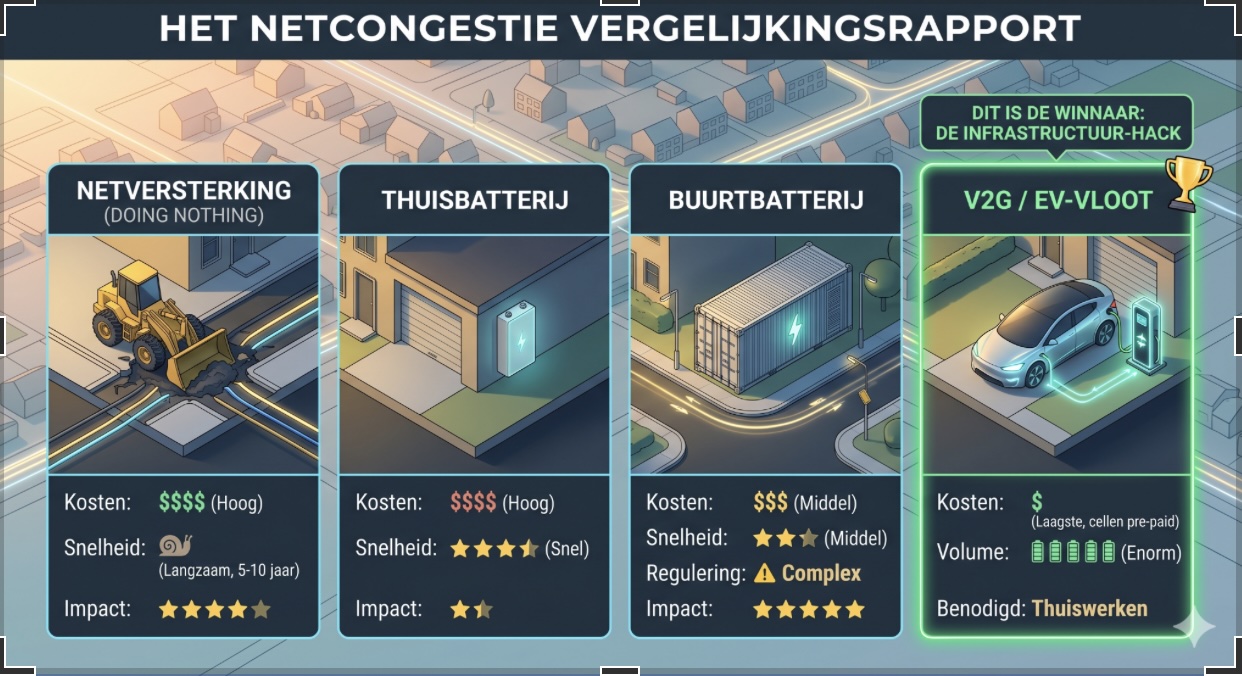
It’s a question we do not ask nearly often enough. The Netherlands is heading toward a massive multi-billion-euro investment in grid infrastructure, the costs of which will ultimately be borne by consumers through rising network charges. Yet there are other options that deserve serious consideration, and the barriers preventing their deployment need to be resolved far more quickly.
Technologically, we are ready. What is lacking is vision, leadership, and the organizational ability to act. When we compare the available solutions at neighborhood level, this uncomfortable reality becomes clear.
(Illustrative estimates based on approximately 800 kWh of required flexibility for a neighborhood of around 80 households.)
1. Grid Reinforcement (The Default Reflex)
Cost: €400,000+ per neighborhood (funded through public resources and network tariffs).
Advantage: A robust, permanent solution to physical grid bottlenecks.
Disadvantage: Extremely slow. Due to acute labor shortages, lead times of 5 to 10 years are increasingly common. In the meantime, the local energy transition grinds to a halt.
2. Home Batteries (The Fragmented Market)
Cost: €600,000 per neighborhood (assuming 80 households each purchase a 10 kWh battery system).
Advantage: Readily available and easy for consumers to install behind the meter.
Disadvantage: Massive hardware redundancy. Eighty separate battery systems and inverters make this the most expensive option per kWh of flexibility. Moreover, these batteries are typically optimized for individual profits in energy markets. Without coordination, they may all charge simultaneously, potentially creating additional strain on the local transformer.
3. The Community Battery (The Power of Scale)
Cost: €350,000 per neighborhood thanks to industrial-scale procurement.
Advantage: More than 70% cheaper than deploying individual home batteries and an ideal physical buffer located directly alongside the neighborhood transformer station.
Disadvantage: Progress is largely blocked by outdated regulations surrounding energy supply, double taxation of stored energy, and rigid network tariffs. Distribution system operators are not permitted to supply energy, creating a legal dead end. Yet a strong argument can be made that community batteries do not compete with energy suppliers. In fact, they could enable suppliers to sell more electricity by allowing additional grid connections.
4. Vehicle-to-Grid (V2G): The Ultimate Infrastructure Hack
Cost: Approximately €137,500+ per neighborhood (investment in around 25 bidirectional chargers, installation costs, meter box upgrades, and the necessary IT and telemetry upgrades at the local substation to safely support bidirectional communication. The millions of euros worth of battery cells are already paid for by EV owners.)
Advantage: This is no longer a distant vision. Renault became the first automotive manufacturer to commercially launch V2G services in the Netherlands in June 2026. The system is highly secure for vehicle owners. Even if software conservatively utilizes only 40% of each EV battery, just 25 vehicles can provide the required flexibility. With 53% of Dutch employees working from home, much of this capacity is already parked in driveways during the day, ready to absorb solar generation peaks at virtually no additional infrastructure cost.
Disadvantage: The solution depends on driver behavior, as vehicles must remain plugged in. It is also currently hindered by EV firmware that may enter sleep mode when charging signals are temporarily paused.
The Fundamental Problem: Fragmented Incentives and Organizational Silos
Why, then, do we continue to invest heavily in the two most expensive options—grid reinforcement and individual home batteries—while community batteries and V2G remain severely underutilized?
Because no single party owns the problem or has the regulatory mandate to solve it.
The energy sector operates through strictly separated bureaucratic silos. Grid operators manage physical infrastructure but are prohibited from operating storage assets. Commercial energy suppliers optimize for trading profits without responsibility for local grid constraints. Automotive manufacturers build vehicles with little incentive to integrate them into neighborhood energy systems.
Every stakeholder optimizes its own silo. The result is suboptimal investments, fragmented solutions, and software that remains largely unaware of real-world grid conditions.
Smart Orchestration Software Is the Only Future-Proof Solution
The solution to this challenge is not simply introducing rigid time-of-use tariffs that penalize consumers for using electricity at the “wrong” moment.
What we need is a grid-aware digital operating system at neighborhood level—one that continuously and dynamically optimizes local generation, storage, EV charging, and the physical state of the distribution network.
Most importantly, consumers should never bear the burden of managing this complexity themselves. People should not have to become energy traders or data analysts, constantly monitoring charts to determine when to charge their car.
The software should solve these problems autonomously and seamlessly in the background.
The vehicle charges intelligently. The community battery or connected EV fleet absorbs peak demand. The grid remains stable. And citizens can simply go about their daily lives without having to think about it.
Renault’s market launch demonstrates that the automotive sector is ready. Dutch smart-grid engineers are among the best in the world. The algorithms already exist.
What is missing is the political courage to break down institutional silos and grant a single party the mandate to conduct this local energy orchestra.
As long as we refuse to orchestrate our energy systems more intelligently and continue operating in isolated silos, we will keep paying premium prices for excavators and cable trenches.