
Why is this happening? Extreme volatility. When the sun shines and the wind blows, power prices crash to zero or even go negative. When the weather turns, prices spike. The legacy grid simply wasn’t built for a decentralized, weather-dependent energy mix.
And while the long-term fix requires digging up a third of the streets in the Netherlands to lay thousands of kilometers of new cables, waiting ten years for infrastructure lead times is not a viable strategy. So the question becomes simple: if we can’t build copper fast enough, how do we operate the grid smarter?
Turning a hardware constraint into a software problem
The answer lies in better orchestration of the assets that already exist. This is where Virtual Power Plants (VPPs) come in. By connecting distributed energy resources such as commercial battery storage, solar installations and industrial loads into a single digital orchestration layer, static assets become programmable grid capacity.
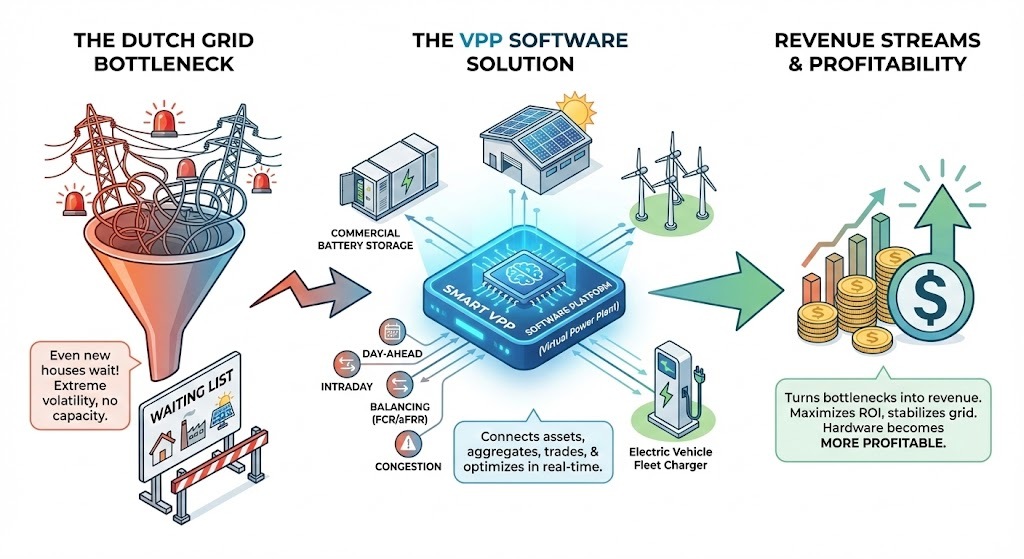
Instead of operating in isolation, these assets can respond dynamically to market signals, congestion and frequency needs. For companies investing in sustainable hardware, this changes the business case entirely. The standalone return on a commercial battery can be difficult to justify. But once connected to a Virtual Power Plant, that same asset can participate across multiple energy markets simultaneously. Suddenly the asset is no longer just infrastructure. It becomes an active participant in the energy system.
Turning flexibility into revenue
Our custom software solutions automatically aggregate and trade flexible capacity across the entire energy market stack:
• Day-Ahead and Intraday markets for continuous price arbitrage
• Congestion markets where flexibility is sold back to network operators to relieve bottlenecks
• Critical balancing markets such as FCR and aFRR that help maintain the national 50 Hz grid frequency
By algorithmically dispatching assets across these markets, flexibility becomes economically viable But more importantly: it helps stabilize the grid.
The real challenge is IT complexity
What many organisations underestimate is that this is not only an energy problem. It is also a software architecture problem. Virtual Power Plants sit on top of a highly complex IT landscape: trading platforms, forecasting systems, asset telemetry, control systems and regulatory reporting. These systems need to work together in real time, with high reliability and strict compliance requirements.
That makes the IT backbone just as critical as the hardware in the field. We wrote earlier about how the success of the energy transition increasingly depends on managing this kind of IT complexity.
Doing the work on essential IT
At Utilus we work on improving and renewing essential IT systems that organisations depend on to operate critical infrastructure. Energy companies are under pressure to innovate quickly while keeping their existing systems running. That is rarely straightforward. Many of these systems have grown over decades and are deeply embedded in daily operations.
Our approach is simple in principle: improve and renew essential IT while the business keeps running. Because if the energy transition teaches us one thing, it is this: hardware alone will not solve the problem. We also have to do the work on the software that runs the system.
From grid bottlenecks to grid intelligence
If your organisation owns or plans to deploy steerable energy assets such as batteries, solar installations or wind capacity, the next step is not just installing hardware. The real value comes from orchestrating these assets intelligently. That requires reliable software, robust integration and an IT backbone that can handle the complexity of modern energy markets.
That is where we help.
Utilus. Do the work.